

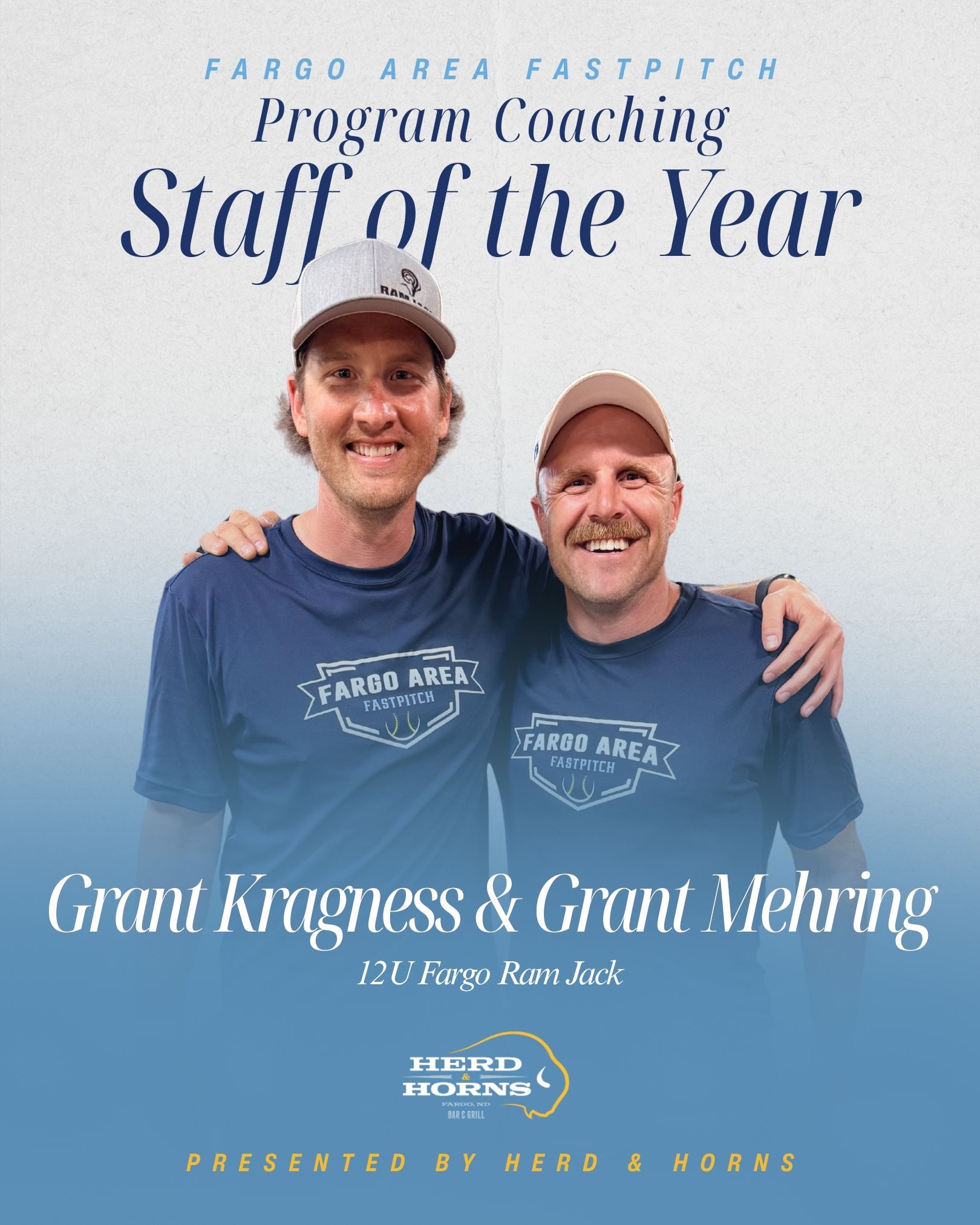
For Grant Kragness and Grant Mehring, coaching the 12U Fargo Ram Jack fastpitch team has always been about helping young athletes grow both on and off the field.
It is about building relationships, developing confidence and resilience, and creating an environment where every player feels valued, supported and excited to come to the field.
Together, Kragness and Mehring brought those values to the Ram Jack dugout, combining years of coaching experience with a shared belief that youth sports can teach lessons that last long after the final out.
Kragness has spent 15 years coaching baseball and fastpitch, a journey that began when he was just 19 years old. Born and raised in North Fargo, he grew up playing football, basketball and baseball. Baseball eventually became his passion, leading him to play for the Post 2 American Legion program before continuing his career at Valley City State University.
Today, Kragness works for Fargo Public Schools as a physical education teacher at Ben Franklin Middle School. With a degree in Physical Education and a minor in coaching, he has spent much of his career working with young athletes in football, basketball, baseball and softball.
Throughout those experiences, one principle has remained at the center of his approach.
“I know it's cliché, but building lasting relationships is the key to coaching,” Kragness said. “Once you have that relationship, you are able to get the most out of your athletes.”
Mehring brings a similar player-first mentality to coaching.
A Fargo native, Mehring has spent the past four years coaching fastpitch while working at Bayer Crop Science. His involvement in youth sports has grown alongside his family. With daughters ages 12 and eight and a five-year-old son, he has coached everything from wrestling and soccer to plenty of fastpitch.
For Mehring, seeing athletes develop physically and mentally is one of the most rewarding parts of coaching.
“I love seeing the progress these kids make in sports from their technical skills, their knowledge of the game and their mental toughness,” Mehring said. “I really just want them to become the best versions of themselves they can as they move out of their sports phase.”
That shared focus on developing the person as well as the player became an important part of the culture Kragness and Mehring created together.
Kragness is competitive and wants his teams to succeed, but he also uses sports as an opportunity to prepare young people for life. During practices, he talks with athletes about how the ups and downs they experience in sports are similar to challenges they will encounter away from the field.
Mistakes will happen. Games will not always go their way. What matters is how athletes respond, learn and get back up.
“Every athlete is different and learns in different ways,” Kragness said. “As a coach, it is important to understand how to connect with each individual and communicate in a way that resonates with them.”
Mehring reinforces that message through something he has incorporated into his teams since he began coaching: the Mental Toughness Minute.
During those moments, players are introduced to mental frameworks and lessons they can use during competition. More importantly, those lessons are designed to extend beyond fastpitch and give athletes tools they can eventually use in school, their personal lives and the working world.
Together, the coaches worked to build athletes who could handle adversity, support one another and understand that their response to challenges often matters more than the challenge itself.
But developing mentally tough athletes did not mean taking the fun out of the game.
Both coaches believe players perform and develop best when they genuinely enjoy being at the field.
“If the kids leave practice thinking it was fun, they will stay motivated throughout a whole long season,” Mehring said.
Kragness and Mehring incorporate games and competitions into practices while using a simple philosophy called “Talk and Touch.”
“Talk” means communicating on the field, encouraging teammates and cheering each other on. “Touch” means high-fives, fist bumps, back taps or extending a hand to help a teammate up.
Those small actions became another way to reinforce the positive, connected team culture the coaching staff wanted for Ram Jack.
That culture also required making sure every player understood her importance to the team. From the beginning of a season, Kragness is honest with athletes about their roles while emphasizing that every role contributes to the team's success.
His approach was shaped in part by his own experiences as a three-sport athlete. Kragness played for coaches he admired and others whose styles he didn't connect with, and he learned from both. Those experiences reinforced the importance of treating athletes with respect, fairness and consistency.
Mehring's coaching journey has involved a different kind of learning.
He didn't grow up playing fastpitch, and rather than pretending to have all the answers, he has embraced the process of continually finding new ones. He searches for drills, techniques and ideas through resources including X and TikTok and brings what he learns back to his players.
That willingness to keep learning reflects the same growth mindset Kragness and Mehring ask of their athletes: be coachable, keep improving and don't be afraid to learn something new.
Both coaches have also experienced the special opportunity of sharing sports with their own families.
Kragness and his wife, Bridget, have two children, Matt, 18, and Peyton, 12. He has coached both in numerous sports, creating memories he says he will always value. Mehring's involvement in coaching has similarly grown alongside his three young children and their participation in sports.
Those experiences have given both coaches an appreciation for the parents and volunteers who make youth sports possible.
For parents who might be considering stepping into coaching, Mehring has straightforward advice:
Just coach.
“We need more parent coaches to be involved,” Mehring said. “So just get into the arena and coach!”
For Kragness and Mehring, being named Fargo Area Fastpitch Program Coaching Staff of the Year is a meaningful honor, but the recognition represents much more than two coaches. It reflects the athletes, families, fellow coaches and supporters who helped make the season possible.
And years from now, neither coach expects their players to remember every score, every win or every loss.
Kragness hopes they remember something more important.
“I hope they remember that I cared about them, treated them fairly, believed in them, and made them feel like an important part of the team,” he said.
That sentiment captures what Kragness and Mehring worked to accomplish together with the 12U Fargo Ram Jack team.
They wanted their athletes to improve as fastpitch players. They wanted them to compete and succeed. But they also wanted them to have fun, develop mental toughness, learn how to respond to adversity and understand the importance of supporting the people around them.
The victories matter.
But for Kragness and Mehring, the relationships and lessons built along the way will last much longer.

Thank you to Herd and Horns for helping us recognize the coaches who make youth baseball possible in our community!