
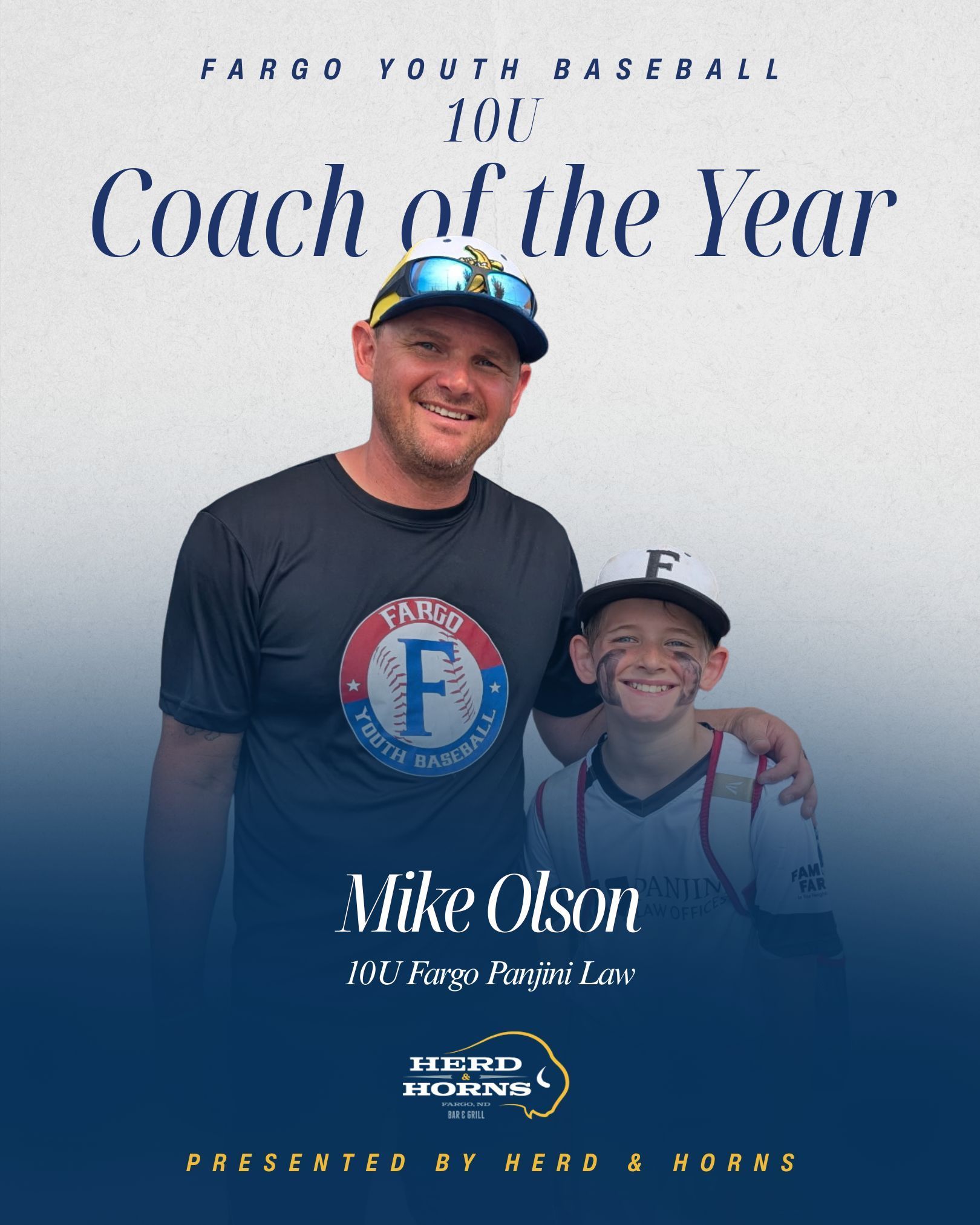
Mike Olson’s love for baseball began long before he ever became a coach.
Growing up in Valley City, North Dakota, Mike spent countless hours in softball parking lots around the country, following his dad’s team from one tournament to the next. But some of his favorite baseball memories didn’t happen on a perfectly groomed diamond.
They happened in the backyard, where bats were shared, ghost runners were part of the lineup, and everyone knew the most important ground rule: Past the tree is a home run.
Those simple games helped Mike fall in love with baseball—not just with hitting, throwing, and winning, but with everything that happens when a group of people comes together around a game they love.
Mike moved to North Fargo in 1999 and graduated from Fargo North High School in 2004. Along the way, sports remained an important part of his life. From baseball and Taekwondo coaches in Valley City to golf and basketball coaches at North High, Mike was fortunate to have coaches who taught him lessons that extended far beyond competition.
Today, Mike continues to be connected to his community through his work with the Fargo Park District. His professional role, along with his experiences as a coach, husband, and father, reflects the importance he places on community, relationships, and creating positive experiences for others.
For Mike, team development comes first. Individual skills matter, but character and teamwork are every bit as important. Baseball isn't simply a collection of individual performances—it is a team game, and Mike wants his players to understand that being a great teammate can matter just as much as being a great ballplayer.
At the individual level, his philosophy is equally simple: meet kids where they are.
Every player is different. They have different abilities, personalities, interests, motivations, and goals. Rather than trying to fit every player into the same mold, Mike believes in getting to know each kid and helping him develop from his own starting point. When possible, he prioritizes development around the parts of the game that excite the player, using that enthusiasm as a foundation for continued growth.
That approach comes directly from the coaches who influenced Mike throughout his own life. The best coaches didn't simply teach him how to play a sport. They took the time to know him as a person.
Mike believes relationships have to come before development.
When a coach makes the effort to understand a player and genuinely care about him, trust begins to form. Once that trust exists, a coach has a much greater opportunity to help a young athlete accomplish his goals—both in baseball and in life.
It is also why Mike considers patience and positivity two of the most important qualities a coach can possess.
Baseball can be an unforgiving game. A player can do everything right and still make an out. Mistakes are inevitable. Slumps happen. Confidence comes and goes. Because so much of baseball is mental, Mike believes young players need coaches who can help them handle those ups and downs rather than allowing a single mistake or bad game to define them.
That doesn't mean practices shouldn't be challenging. It means development should still be fun.
Mike likes incorporating games and competition into practices while keeping the focus on improvement. He also makes sure his players understand that team practice is for the team. It's a place to learn how to work together, support one another, communicate, compete, and become something greater than a collection of individual players.
Away from the field, Mike is a husband to Becky and a proud dad to Aubrey and Cody. Those roles reinforce something he already learned from the many coaches who helped shape his life: the impact adults have on young people can extend well beyond a season.
That's why, if Mike could offer one piece of advice to a new coach, it wouldn't be about lineups, drills, mechanics, or strategy.
Make time to get to know your players.
Learn who they are. Find out what motivates them. Earn their trust.
Because before a coach can develop baseball players, he has to build relationships. And when individual players begin trusting their coach and caring about one another, something bigger starts to happen.
They become a team.
For Mike Olson, that's what baseball has always been about.

Thank you to Herd and Horns for helping us recognize the coaches who make youth baseball possible in our community!